

 Español






Share:


Keynote Speaker: Ramón Espinasa
-
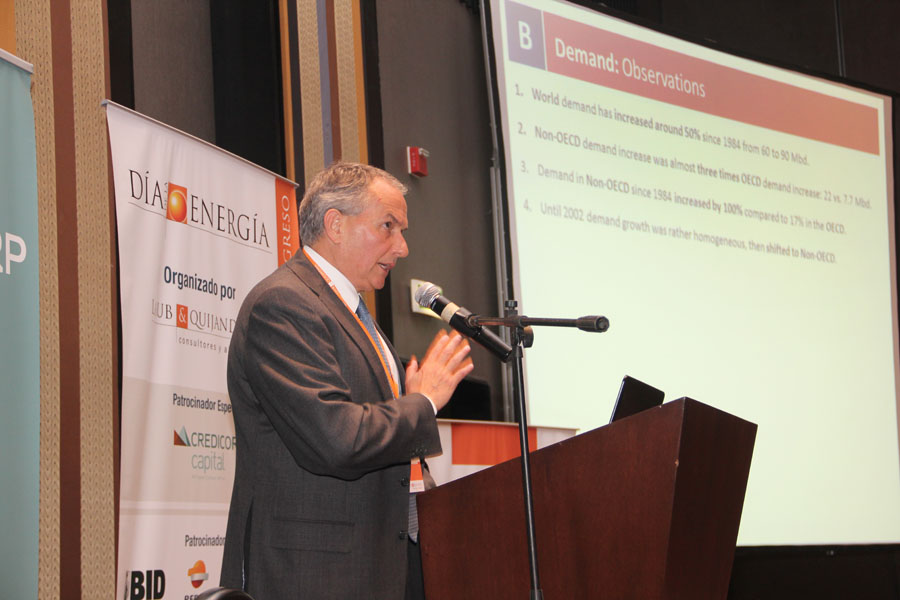
Ramón Espinasa, leader economist in the oil and gas sector of Inter-American Development Bank. His speech (See Presentation) taddressed different interesting issues:
(i) The increase in oil demand in the countries of the region,
(ii) The importance of developing a competitive energy supply,
(iii) The impact of shale gas on the market price of gas and natural gas liquids in USA as well as in the international market.
According to Dr. Espinasa, oil price has experienced a structural change. After decades of stable prices, nowadays they have been doubled; a trend that most commodities have followed. Since 2008, there has been a constant increase because of the demand coming from developing countries, especially Asian countries (China and India). Non-OECD countries have multiplied their oil use; meanwhile, OECD countries’ demand has been stable. In the medium-term, it is expected that USA will be replaced by China in the oil use within the market. The activity sector that will demand oil the most will be transport.
On the supply side, it has not increased within the OECD countries; meanwhile, it has considerably increased within the non-OECD countries. The supply increase comes from OPEX and developing countries, especially Middle East Countries. The deficit conventional oil will be compensated with the development of new oil fields, increase of recovery rate, production of shale oil fields and refining profits.
With regards to Latin American Countries, it was stated that production in Mexico, Bolivia, Ecuador and Argentina have decreased; meanwhile, production in Brazil and Colombia has increased. The main risks of the industry in Latin American Countries are: price control, strong subsidies, uncertain rules, inefficiency due to lack of competence, discretionary management of royalties and their distribution.
With regards to the Peruvian market, he stated that oil production has decreased, but it has been compensated by the natural gas liquids of Camisea. Finally, Dr. Espinasa warned of the decrease of number of drilled wells and medium-term negative implications related to the production of hydrocarbons in the country.
Download Presentation:
Temas Relacionados
